Your Data Center Is a Boiler
Part 5 of 5 · The Thermal Series
Nearly all the electricity that goes into a data center comes back out as heat, and we vent it into the air while nearby buildings burn gas to make heat. A few places have stopped throwing it away.
By Jeff Nichols
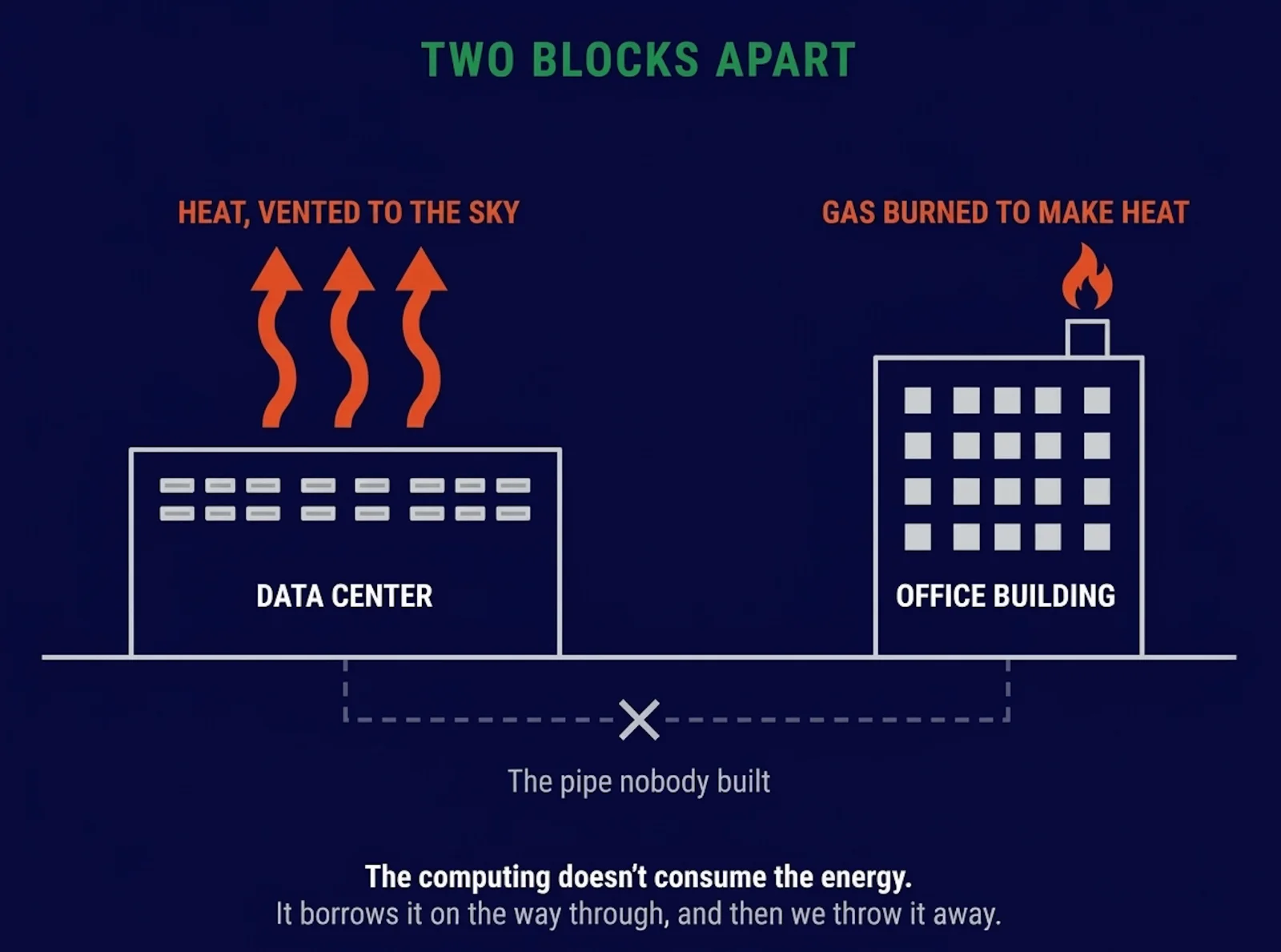
A data center is, thermodynamically, a building-sized electric heater that performs computation as a side effect.
Nearly all the electricity that goes in comes back out as heat. The computing doesn’t consume the energy, it borrows it on the way through. Then the cooling system takes that heat, moves it outdoors, and releases it into the air, where it’s worth nothing to anyone.
Meanwhile, two blocks away, a building is burning natural gas to make heat.
That’s the whole post. Everything below is detail about why this persists, and what a few places have done about it.
The scale of what gets thrown away
Low grade heat is the single largest waste stream in any developed economy, and it’s almost entirely invisible because it has no market and no meter.
The sources are everywhere once you start looking. Data centers and server rooms. Supermarket refrigeration, which spends all day pumping heat out of cold cases and into the parking lot. Ice rinks, which do the same thing more dramatically. Industrial processes. Wastewater, which runs warm under every street in every city, continuously, all year.
The reason none of it gets used isn’t technical. It’s that this heat is low grade, meaning it comes out at temperatures too low to be useful for most industrial purposes, and heat doesn’t travel. A gigajoule of waste heat in Tukwila is worthless to a building in Ballard. It’s only valuable to something close enough to reach with a pipe.
That makes waste heat the opposite of a commodity. It can’t be traded, shipped, or stored economically. It can only be matched, locally, between a specific source and a specific use.
Which is exactly the kind of problem a district energy network exists to solve.
Heat pumps changed the arithmetic
For most of the history of this idea, the temperature problem was decisive. Waste heat comes out at 20 or 30 degrees Celsius and buildings want water at 60 or higher. You can’t bridge that with a pipe.
Industrial scale heat pumps bridge this by taking low grade heat and raising it to a useful temperature, and they do it at better than three to one, meaning more than three units of delivered heat per unit of electricity consumed.
That ratio is what makes the whole proposition work. It means a megawatt of electricity can move three or more megawatts of otherwise worthless heat into a district network. Compare that to resistance heating at one to one, or a gas boiler at somewhere below one, and the economics stop being marginal.
Places that actually do this
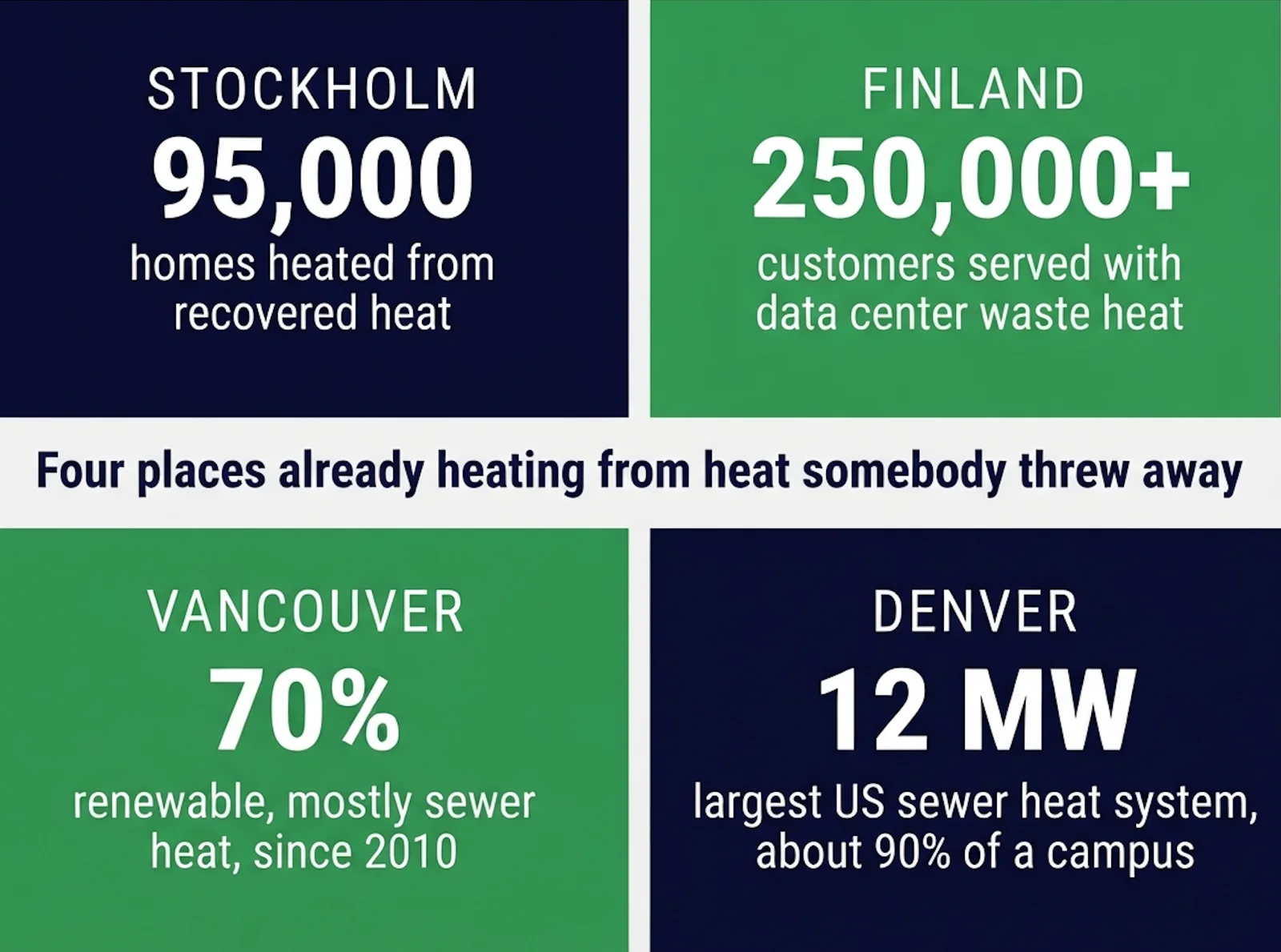
Stockholm Exergi runs a district heating network that recovers heat from supermarkets, ice rinks and data centers. One of their wastewater heat recovery facilities, among the largest operating anywhere in the world, heats roughly 95,000 homes.
In Finland, Fortum captures waste heat from data centers and diverts it into district heating serving more than 250,000 customers.
Closer to home, Vancouver's False Creek Neighbourhood Energy Utility has been recovering heat from raw sewage since 2010, built originally for the Winter Olympics. It now runs about 70% renewable, predominantly from sewer heat. At the end of 2024 it added two heat pumps for another 6.6 megawatts, bringing it to 47 buildings served. The target is fully renewable by 2030, avoiding around 7,000 tons of carbon dioxide equivalent annually.
And in the United States, the largest sewer heat recovery system currently operating is at the National Western Center in Denver. Twelve megawatts, meeting close to 90% of the campus heating and cooling demand, drawn from a single sewer main.
That Denver system is operated by CenTrio, which is the same company that owns the steam network under downtown Seattle.
The Seattle version is already starting
King County's first sewer heat recovery project is expected to supply roughly 70% of the heat for a 1.6 million square foot life science campus.
That’s a serious project and a genuine first for the region. It’s also one project assembled because a specific developer and a specific utility found each other, rather than because anyone mapped the city's thermal sources and matched them to its thermal demands.
Seattle has the ingredients. An 18 mile steam network under downtown, a wastewater system under everything, and a growing data center presence in the region. What it doesn’t have is an entity whose job it is to connect them.
About those data centers
I want to say something here that runs against the current mood. Data centers are taking the blame for a lot of things they didn’t do. The story that has settled in is that they’re consuming all the power and driving up everyone's bills, and when you look at what has actually moved prices in this region over the past five years, it’s weather. Heat domes, cold snaps, low water years.
Dawn Lindell made this point to me, and it stuck, because she ran a utility through exactly those weeks. In her experience, most of the load growth she dealt with was transportation electrification, building electrification, and ordinary local growth rather than server halls.
Here’s the version of the data center argument I find more interesting. A data center is a large customer with capital, a long time horizon, a continuous and predictable load, and a direct financial interest in grid reliability. It’s also, as established above, a very large heat source sitting in a fixed location.
If a city engaged with that seriously rather than treating it as something to be endured, the waste heat alone would be worth negotiating over. Fortum is heating a quarter of a million customers with it.
The fight we’re currently having is about whether to allow data centers, but the fight worth having is about what we get in return when we do.
Why this isn’t happening here
Three reasons, none of them technological. The first is that nobody owns the problem. Waste heat recovery requires a source, a use, and a pipe between them, usually under a public street, involving at least two private parties and a municipality. In the United States there’s rarely a body with the authority and the mandate to assemble that.
The second is that the heat has no price. A data center operator throwing heat into the air faces no cost for doing so and earns nothing for capturing it. Until that changes, waste heat capture is a cost center with no revenue line.
The third is that our planning machinery is electric. We have detailed processes for interconnecting generation and almost nothing for connecting thermal sources to thermal loads.
None of those are hard problems in the way that long duration storage is a hard problem. They’re organizational problems, which in some ways makes them more frustrating.
Where we fit
Pilotlight is a compliance platform for building performance standards, which means we work on the demand side of this: what individual buildings consume and report.
The connection to waste heat is that you can’t match thermal sources to thermal loads without knowing where the loads are and how large they are. Benchmarking data, collected building by building because Washington's Clean Buildings Performance Standard requires it, is the closest thing the region has to a map of its thermal demand. It was built for compliance, but it would also be the starting point for anyone trying to do this properly.
If you aren’t sure which standards apply to your building, our compliance navigator will tell you in about a minute, and it’s free.
Sources
- The Good Climate, The Heat Under the Street
- Reshape Strategies, Sewer Heat Recovery at the False Creek Neighbourhood Energy Utility
- The Tyee, The Future of Home Heating? It’s in the Dishwater (September 2024)
- National Geographic, Waste Wattage: Cities Aim to Flush Heat Energy Out of Sewers
- Euroheat and Power, District Heating and Cooling Market Outlook